“What’s your contact stance?” An all too familiar question within this community. Even people such as myself that choose not to use contact stance labels are still asked about it, and it’s treated like something that everyone must take a stance on. Between “pro-c”, “anti-c”, “contact void”, “contact complex”, “contact neutral”, and a slew of blankqueer labels that dictate contact stance, which do we label ourselves with? It’s a choice we must make in this community in order to find where we belong… or is it?

One of the most interesting results from my survey so far has been that a noticeable majority of respondents self-identify their contact stance as being “complex contact” for MAP/AAM and zoo/animal relationships. I find this fascinating, as I feel like I rarely see people use that label, but perhaps those that do not label their contact stance do so because of being complex-c? It’s worth noting that there is still a majority of respondents that are either pro-c or anti-c, so it might not be accurate to say that the majority of our community holds this opinion, but it is still important that more people identify as complex than any other stance on their own. (It’s also worth noting that these results could be due to some sort of bias, but I think they still hold weight.)
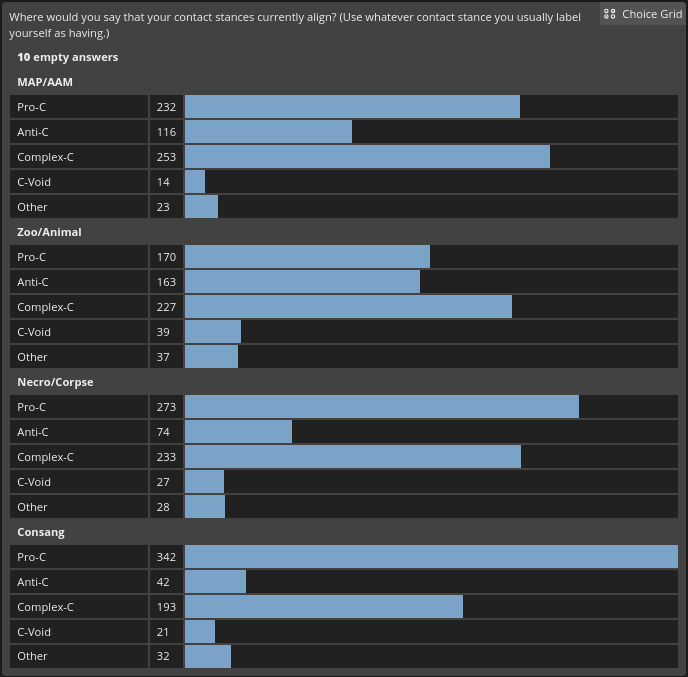
As you can see, the majority of respondents choose to identify as complex-c for MAP/AAM / zoo/animal relationships. However, there are still more people who identify as pro/anti-c if you sum those up, meaning that, yes, more people identify as either pro/anti-c, but there are still more people identifying as complex-c than either one independently. Curiously, necro/corpse / consang contact are far less polarizing. With an overwhelming majority of respondents identifying as pro-c for consang (more than the sum of anti-c, complex-c, c-void, and other) and a simple majority of respondents being pro-c for necro/corpse (the sum of the other responses being larger than the responses for pro-c).

So this begs the question, is contact stance really something we as a community should be focusing on? Opponents (such as myself) argue that contact stance just divides our community, while proponents argue that it’s necessary to divide people, as those on one side are predators, while those on the other side are ageists (or speciesists, or what have you), and anyone who doesn’t pick a side is being a “centrist.” But if the majority of people really hold complex views, is that “necessary” divide actually accomplishing anything? 

Contact stance can indeed tell some important information. For instance, someone may identify as anti-c because they hold ageist views about minors not being able to make their own decisions, but that doesn’t necessarily apply to everyone. Someone may also identify as anti-c because they think breaking the law is too risky for all parties involved, but they do think that kids can consent. These are two very different opinions, but they both simplify to “contact bad,” and that’s where things start to get messy.

You can say the same thing about pro-c’s. The vast majority are pro-c because they value the autonomy of youth, but there are indeed pro-c’s out there who are predators. If this is the case, then why do pro-c spaces only care about whether you think pedophiles should be allowed to have sex with children? If most people value youth autonomy, but some do not, then shouldn’t youth autonomy be the thing we care about, not the simplification of “contact good?”

Contact stance labels are just way too simplifying. They attempt to take complex opinions about consent, autonomy, and power dynamics, and dumb it down to being pro or anti “contact.” What even is contact? Many think of sexual contact when they hear it, but, for instance, MAPs are attracted to kids in more ways than just the sexual, so does contact stance include romantic “contact” too? I would assume that at least some people who are anti MAP/AAM sexual contact would be more lenient for romantic contact, so why don’t we see people saying that in their bios? It’s just because the goal of contact stance labels are to simplify things, but I think that is a goal that is harmful to the harmony of our community.

These distinctions can be useful at times, but I would argue that they cause more harm than good, and that we should focus on the real opinions that people hold, and not just what “contact stance” they fit into. In a space that highlights youth autonomy, we inherently filter out abusers and ageists, and leave in all of the people that we do want in our community. That is what we should be doing instead.

When asked, I tell people I am pro-c, because that is the truth. I don’t like having to label myself, but if someone asks then I have to give an answer, and that’s the one that fits me the best. I do think that youth can consent to relationships with adults, and while there is definitely complexity involved, I don’t find that complexity to be very useful to label. Adult/adult relationships are complex too, but it wouldn’t make sense to label as “complex-c” in those situations, because complexity is inherent to all relationships. Many use contact stance as a label for whether adults/kids / zoos/animals / etc can consent to relationships, but at the end of the day what’s more important is allowing autonomy, and that’s where my pro-c stance comes from. Youth should have the autonomy to do what they want, while also having support and educational structures. That autonomy includes sex with adults, but that isn’t nearly as important as the autonomy in general. 

So why don’t I just label myself as pro-c then? Like I said earlier, I am an opponent of contact stance because it is too simplifying, which in turns becomes divisive. Anti-c’s see the term pro-c as a cover for being a predator, so if I just call myself pro-c then I’m not getting my real opinion across. And I’m guessing I’m not the only one who feels that way, as we can see from the survey results. Many choose not to label their contact stance because it cannot be simplified to pro or anti, and I am one of those people.

This is a case for contact stance abolition. We see many use terms like “contact void” to describe not wanting to have a contact stance, but I think we should instead normalize not having a contact stance at all, and abolishing it. Instead, let’s replace these simplifications with how we really feel. Are we pro-youth-sexual-autonomy? Are we anti-nonconsensual-abuse? Let’s say that instead.
Fediverse reactions

Tags

Comments

15 responses to “A Case for: Contact Stance Abolition”

  1. Anonymous

    I think it may be necessary to separate political convenience with morality or biology before further examining the necessity of narrative separation, and the alleged sabotage from the LGBT community or liberals against YAPs. I think it is necessary to separate things like Zoo or marginalized minority discourse from YAP because they’re aren’t the same functionally speaking. One can argue that YAP sentiments are more natural than Zoo because of attraction to youth, or neoteny, that leads to reproduction. Such attraction can introduce better chances for pregnancies and overall health, and even with homosexuality aspects it can possibly create better intergenerational relations of males and females, or adoptive parents. When I was concerned about state and societal repression on natural youth attraction, I was pointing out that it could have genetic compounding effects by directly or indirectly suppressing youth mating and YAP individuals. I think so because I believe there may be individual differences in attractions, or in the intensity and willingness to act upon those attractions. I know it isn’t fatalistic in this sense or within a single generation, but it could add up each generational and make us all sicker and biologically older as a result of poor mating selection in due time.

    That much of the discourse can’t be said of zoo, despite however we may feel about it. The best you can get from inter-species breeding is something like a mule or at worst a chimeric offspring in constant pain which can only survive in laboratory settings, if it hasn’t already died. In addition to that perspective, I think there may by a strong natural disgust response in bestiality that isn’t as negotiable as something like youth attraction or homosexuality. This may simply be due to the lack of reproductive advantages that zoo could offer, including many negatives. Disgust is sometimes a natural response to unhealthy things, even if it isn’t universal in all humans or in every situation. It isn’t really relevant to point out how liberal one should be on the issue either, which wasn’t my intent. My only intent was to explain why we should separate discourses.

    The minority marginalization discourse simply drives a further wedge into YAP for no good return, all speculative theory and political “science”. All the political factions already have their territories and positions for power plays, a distinction of politics in the discourse I feel will just make it more dangerous for the movement by those power players against us, and ultimately a lost cause that will fail.

    This is coming personally from a newly discovered identity in heterosexual Hebephilia for a few years, and I was confused as to why the discourse was stagnating or very confusing to new people and outsiders. I have no clue where I stand politically, possibly everywhere at once?

    Yes, I know clinical pathology terms like Hebephilia are bogus, but you get the idea.

    1. I’m not so sure. Look at what happened in the past with NAMbLA. They got pushed out of the gay rights movement. If we try to gain just MAP rights again then it’ll just be the same thing all over again. I think it’s important that we try something different this time around, and that difference is building a queer movement that isn’t going to repeat the same mistakes of pushing out people who belong with us. LGBTQ+ started with just gay people, and from there on they welcomed lesbians, bisexuals, and eventually transgender people. Let’s just skip the middleman and build a movement where everyone queer is welcomed by default.

  2. Anonymous

    A few comments so please respond,

    1. I fear that if this discrimination continues it may have profound genetic impact against neoteny, attraction to neoteny, and impair the health of many populations by means of the increasing lawfare and mob violence.

    2. I strongly suggest a move toward offensive politics. Most of those so called Antis are actually pro-slavery, youth slavery. We being anti-harm is more accurate and pro-autonomy. Pro-auto, pro-free, sex-free, or anything you could suggest is better than what is used in this community now. Anything that is centered around the presumption of harm or not is counter to the image and goals, because it moves dialogue into enemy territory. It should actually be the enemy who has to constantly come up with new terms to defend its unnatural position.

    3. Discourse conflation. Does ZOO discourse really need to be put in the same camp as MAP discourse? Do we really need tangentially marginalized groups to compare or share similar ideals to the YAP struggle? We must remember that not all in YAP are left winged but also center to right, and many not even on the political wings or scales. Many are so unpolitical that would seem our lexicon and discourse very out of touch.

    1. 1. I’m not quite sure what you mean by this.

      2. I somewhat agree. I don’t like to be offensive myself, but I agree that arguments presuming contact to be “harmful” are not going to be helpful in the long run. If we want rights we need to stick up for ourselves and not let our oppressors control the argument. But that is different than contact stance. The point I’m trying to make is that our communities should focus less on labels and more on what actually matters. A community that emphasizes youth rights is inherently going to filter out anyone who thinks that “contact” is abusive.

      3. I think so. Throughout history LGBTQ+ has always tried to let people in one at a time. First it was gays, then lesbians, then bisexuals. Pedophiles were among some of the first to be let in, but in order to save fact they were thrown out. I don’t think we can afford to repeat that. We must create a queer movement where everyone is accepted right away, not one at a time, and we don’t throw people under the bus. By doing so we are increasing our strength in numbers. As far as politics go, I am very far left and don’t really care for right wing MAPs. I’ve seen the way people on boychat are sexist and racist, and I don’t want to build a movement with people like that.

  3. Anonymous

    “Pro-reform” or “pro-choice” might be the best terms to use, depending on your current perspective…

    I’m all for unity and putting aside differences to work on humanizing MAPs and stopping them from being sent to gas chambers. That’s all well and good. The problem is that past a point, the two sides are likely to clash. If “pro-c” people who wish to see law reform that would distinguish between mutually willing sexual contact and violent assaults in cases of mutually willing sexual contact with someone under the age of 18 (how “child” is defined by the United Nations and according to mimetic internet nonsense now seeping out into everyday discourse *sigh*) – all the while taking young people’s perspectives into account – but the anti-c people label them “predators” who want to “rape children,” then their worldviews are at a point irreconcilable.

    The problem with the Anti-c position is that they’re wrong. They’re wrong that all cases of age-gap sex that breach the magic age line are inevitably harmful to the younger person’s mental health, devoid of any context, as if we exist outside society and all history hitherto wasn’t littered with perfectly functional age-gap relationships… We literally have tons of scholarship on how pederasty was the dominant form of male same-sex practice prior to the 1950s (I am paraphrasing the historian Kadji Amin here). We even have more recent literature, before MAP hysteria peaked, documenting young people’s positive experiences and testimonies. Your various empirical studies by Allie Kilpatrick, Paul Okami, Theo Sandfort, Bruce Rind, Gilbert Herdt, and many other research papers published by less well-known authors… Your historical papers by Amanda Littauer, Rachel Hope Cleves, Nicholas Syrett, and so on, showing the same.

    “Pedophilia” specifically – a sexual presence directed towards pre-pubescent children – that is abnormal. It’s non-normative, without question. But that doesn’t mean it’s evil, or has no purpose, evolutionary benefit, etc. (Depending on what theoretical lens you want to use)… But sadly, in America in particular, “pedophilia” has been subject to massive ‘concept creep’. The category has expanded to include anyone who at anytime expression attraction to anyone under 18, i.e. everyone. It’s become a political and social bludgeon. It’s well-evidenced that men in particular are attracted to neoteny – the retention of juvenile characteristics into adulthood – particularly in the face and smooth, taught skin. You’ll find that many, many models have exactly that – young looking faces but wide, child bearing hips. But now, attraction to youth, the thing we literally need to reproduce the species, gets falsely stigmatized as “pedophilia.” It’s ridiculous, and it needs to end.

    But you know what won’t end the hysteria? Ceding the ground that a 17-year-old is a “child” on the same level as a 7-year-old; that their capacities, decision making abilities etc., are for all essential purposes the same. That any sexual experience a young person has is tantamount to “abuse,” “rape,” or “sexual assault” if it happens to involve a proscribed or unusual (to you) age-gap, regardless of context and the young person’s own feelings about the matter. “Rape” is unwanted sex imposed on another person against their will. It is not a 17-year-old having mutually willing sex with their 21-year-old partner, which would’ve been totally unremarkable in the fairly recent past. These distinctions are meaningful and matter. Ceding them renders the premises of anti-c ideology illogical and patently false. Whilst there is real “abuse,” obviously, it helps no one to conflate violent assaults with everyday sexual activity that would usually be seen as perfectly A-OK if it occurred between two underage peers…

    Have you ever heard of the “explosion principle” in philosophy? Basically, it’s the idea that once you accept a false premise as an axiom, anything can be true / follow as a consequence. If you accept that pigs are animals that can fly (when they provably cannot), then suddenly they could do other things too; can they fly across a country like birds do?; can they fly above the clouds like an airplane? Perhaps they can breathe fire? This kind of BS is what’s been happening with MAPs, non-MAPs, and age-gap sex since the late 1970s. Once you accept the false premise that non-violent, mutually willing sexual behavior involving X or Y age-gap is intrinsically harmful despite evidence to the contrary, suddenly you’re opened up to questioning why a 28 and 38 year old should be allowed to be together since there’s a presumed “power difference,” or whatever other abstract, unfalsifiable discourse you use to justify your falsehood. It’s one reason for the endless mental gymnastics, the constant turn to abstraction, the hate for empirical science and academics who research people’s actual lived experiences (see e.g. Susan Clancy’s case)… Why won’t the Antis permit dissent? It’s because they know that if their ideas were tested and examined, they’d be wrong. They know it. Theo Sandfort, Allie Kilpatrick, Paul Okami, Rachel Hope Cleves, and many, many more…

    [I recommend reading https://www.ipce.info/imo-archive/books/asb/comm_okami.htm , taken from the larger https://www.ipce.info/imo-archive/books/asb/comm_frame.htm ; Anyone can read the original source by pasting the journal link into sci-hub – link: https://link.springer.com/article/10.1023/A:1020603214218 ].

    I totally understand that “predator” discourse is popular and it’s much easier to follow the madding crowd and try to fit-in, even if means using highly emotive, sensationalist and / or dehumanizing language that is often used by people who seem to hate you just for existing. It’s easier to not argue about when X or Y can be positive when the cultural climate is so toxic it renders any real-life case fraught, dangerous, and unlikely to have positive consequences even though the initial sexual contact was experiences as positive or neutral. Police getting involved, hysterical parents, families breaking up and people losing safety, jobs, homes, sometimes their lives, make it seem pointless to bother arguing the case.

    But that doesn’t mean you’re correct, and it doesn’t mean that ceding to the Anti’s discourse will save you. They hate you, they want you dead. You’re a “ticking time bomb” to them and they do not believe you’ll never “offend” because they’re aware of how much they use porn, chat up women / men or have strong desires, and don’t believe that you’re an asexual sponge. And they’re right – you’re not. So whilst not wanting to break the law is great, and I’d encourage everyone to live their best law-abiding lives, frankly put: the Anti-c people deny reality. They’re wrong, and they perpetuate falsehoods and toxic (i.e. “abuse” / “predator” discourse). The only good they’ve done is help bolster the distinction between attraction and action, but that’s largely in academia which the public at large don’t care about anyways.

    I say this as someone who is not an MAP and has researched the topic extensively within scholarship: you’re not helping, Anti-cs. I respect what you’re doing by trying to humanize people, but ultimately the public think that any stray touch from you that lands on a person under 18 is going to make their brain explode and turn them into a traumatized sexual cripple for eternity.

    Worse, they think that by looking at a picture of video of someone under 18 with even a hint of erotic significance, even if the person is long dead, is “victimizing” the person involved. Literal voodoo logic, which in countries like the UK is extending to cartoons. Literally, “protect the pixels” level of derangement. The hysteria has gotten so out of hand, and to throw one’s hands up and say “we accept all your premises, but don’t worry, we don’t offend, we don’t even look at cartoons!”, is not helping anyone. The walls are closing tighter and tighter, with moves by government to try and smoke you all out and make a “virtuous” life unlivable and impossible. Put simply, to invoke Karl Andersson’s recent book about Shotacon, it’s not you that’s on trial, it’s your desire. No longer does anyone really care if you harm a child, it’s now all about hunting down people *like you*. You, like what Michel Foucault once said of homosexuals, have become a “species,” a different category of person… From sex dolls to drawings and cartoons – if it ever becomes possible to read people’s minds and hear their thoughts – I can see it becoming a criminal offence to think sexual thoughts about a “minor” / “child.” Because that’s what the haters, the Antis care about: they hate you for your inner life, your desire, the very fact that you have sexual thoughts or fantasies that they find disgusting or uncomfortable. Seen from this perspective, saying you’re “non-offending” is a moot point. They don’t care. You’re a “pedophile” to them and that’s enough to condemn you and perhaps even kill you.

    If you actually address the bullshit people are saying – all of it not just part of it – society could perhaps move towards something fair and proportionate based off reason, evidence and reality. As it stands, you’re acting in a noble manner but playing in to your haters’ hands…

    Good luck out there, whoever you are…

    (Thanks for coming to my Ted Talk! :p )

  4. Anonymous

    Hello

  5. Anonymous

    The fact that people make such a big deal about sex is crazy. If all the parties involved want to have sex and no one feels like a victim, then it’s nobody’s else business.

    1. Anonymous

      this

    2. Anonymous

      Based and epic.

  6. Anonymous

    interesting

  7. Anonymous

    zoo being less pro-c might have to do with sampling, the majority of zoo communities don’t even humor contact discourse because active zoophilia is the entire point, though this result is nonetheless interesting. excited to see what other results we see from this survey

  8. Anonymous

    I strongly dislike pro-contact because there seems to be a group of people who real stance is just pro-adults doing whatever they want. Like people who complain about those who were abused by Catholic priests

    1. for what it’s worth i’ve never met any pro-c’s who held that opinion, every pro-c i’ve met cares strongly about the autonomy of who they’re attracted to. it sounds like what you described might just be a loud minority. hence why i think advocating for autonomy is more useful

  9. Anonymous

    “Are we anti-nonconsensual-abuse? Let’s say that instead.”
    That’s even more vague because what exactly would a person count as being “non-consensual”?

    1. you have a point, i was just trying to think of another example and failed. the point i was trying to make is that oftentimes it seems like anti-c’s assume that pro-c is explicitly trying to be abusive and nonconsensual

Leave a Reply

Your email address will not be published. Required fields are marked *

About the author

Ally Kotetsu is a radqueer content creator. She writes to a blog, livestreams, releases music, and more!

FOLLOW ME ON THE Fediverse

Ally Kotetsu
Ally Kotetsu
@ally@allykotetsu.com

Radqueer hype.

73 posts
77 followers

DONATE

PayPal

cards
Powered by paypal

Ko-Fi

Buy Me a Coffee at ko-fi.com

Monero

87JR2ziMAwXRhkLpzdKtMxRQLMAL6huCk21F3vRWwGmVC65nqDsorACdfTmEHWmjQCc8Udw1tqRCbKDY2PCm7Swx8hvKbL3

Bitcoin

bc1qr0uwkqg2llz3qjjtfp5py9k3a7vztg5sgpny25