"What's your contact stance?" An all too familiar question within this community. Even people such as myself that choose not to use contact stance labels are still asked about it, and it's treated like something that everyone must take a stance on. Between "pro-c", "anti-c", "contact void", "contact complex", "contact neutral", and a slew of blankqueer labels that dictate contact stance, which do we label ourselves with? It's a choice we must make in this community in order to find where we belong... or is it?
One of the most interesting results from my survey so far has been that a noticeable majority of respondents self-identify their contact stance as being "complex contact" for MAP/AAM and zoo/animal relationships. I find this fascinating, as I feel like I rarely see people use that label, but perhaps those that do not label their contact stance do so because of being complex-c? It's worth noting that there is still a majority of respondents that are either pro-c or anti-c, so it might not be accurate to say that the majority of our community holds this opinion, but it is still important that more people identify as complex than any other stance on their own. (It's also worth noting that these results could be due to some sort of bias, but I think they still hold weight.)
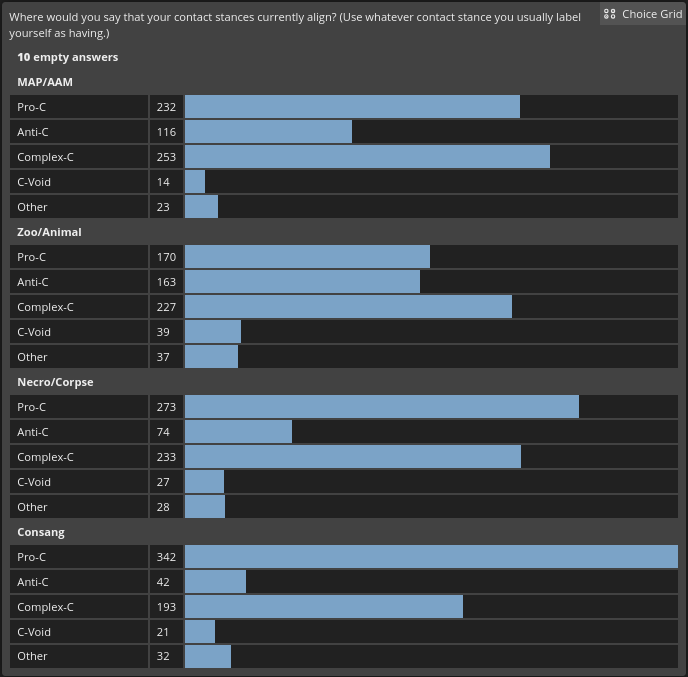
So this begs the question, is contact stance really something we as a community should be focusing on? Opponents (such as myself) argue that contact stance just divides our community, while proponents argue that it's necessary to divide people, as those on one side are predators, while those on the other side are ageists (or speciesists, or what have you), and anyone who doesn't pick a side is being a "centrist." But if the majority of people really hold complex views, is that "necessary" divide actually accomplishing anything?
Contact stance can indeed tell some important information. For instance, someone may identify as anti-c because they hold ageist views about minors not being able to make their own decisions, but that doesn't necessarily apply to everyone. Someone may also identify as anti-c because they think breaking the law is too risky for all parties involved, but they do think that kids can consent. These are two very different opinions, but they both simplify to "contact bad," and that's where things start to get messy.
You can say the same thing about pro-c's. The vast majority are pro-c because they value the autonomy of youth, but there are indeed pro-c's out there who are predators. If this is the case, then why do pro-c spaces only care about whether you think pedophiles should be allowed to have sex with children? If most people value youth autonomy, but some do not, then shouldn't youth autonomy be the thing we care about, not the simplification of "contact good?"
Contact stance labels are just way too simplifying. They attempt to take complex opinions about consent, autonomy, and power dynamics, and dumb it down to being pro or anti "contact." What even is contact? Many think of sexual contact when they hear it, but, for instance, MAPs are attracted to kids in more ways than just the sexual, so does contact stance include romantic "contact" too? I would assume that at least some people who are anti MAP/AAM sexual contact would be more lenient for romantic contact, so why don't we see people saying that in their bios? It's just because the goal of contact stance labels are to simplify things, but I think that is a goal that is harmful to the harmony of our community.
These distinctions can be useful at times, but I would argue that they cause more harm than good, and that we should focus on the real opinions that people hold, and not just what "contact stance" they fit into. In a space that highlights youth autonomy, we inherently filter out abusers and ageists, and leave in all of the people that we do want in our community. That is what we should be doing instead.
When asked, I tell people I am pro-c, because that is the truth. I don't like having to label myself, but if someone asks then I have to give an answer, and that's the one that fits me the best. I do think that youth can consent to relationships with adults, and while there is definitely complexity involved, I don't find that complexity to be very useful to label. Adult/adult relationships are complex too, but it wouldn't make sense to label as "complex-c" in those situations, because complexity is inherent to all relationships. Many use contact stance as a label for whether adults/kids / zoos/animals / etc can consent to relationships, but at the end of the day what's more important is allowing autonomy, and that's where my pro-c stance comes from. Youth should have the autonomy to do what they want, while also having support and educational structures. That autonomy includes sex with adults, but that isn't nearly as important as the autonomy in general.
So why don't I just label myself as pro-c then? Like I said earlier, I am an opponent of contact stance because it is too simplifying, which in turns becomes divisive. Anti-c's see the term pro-c as a cover for being a predator, so if I just call myself pro-c then I'm not getting my real opinion across. And I'm guessing I'm not the only one who feels that way, as we can see from the survey results. Many choose not to label their contact stance because it cannot be simplified to pro or anti, and I am one of those people.
This is a case for contact stance abolition. We see many use terms like "contact void" to describe not wanting to have a contact stance, but I think we should instead normalize not having a contact stance at all, and abolishing it. Instead, let's replace these simplifications with how we really feel. Are we pro-youth-sexual-autonomy? Are we anti-nonconsensual-abuse? Let's say that instead.
- Ally K <3
Add new comment